Key Takeaways
- Natural vs. Unnatural: Trees leaning toward sunlight are usually stable; trees leaning due to root shifts are hazards.
- The Root Plate: Soil heaving or cracked ground on the side opposite the lean is a sign of imminent collapse.
- Species Sensitivity: Fast-growing Northwest Missouri species like Silver Maples are more prone to leaning-related failures.
- Target Assessment: A leaning tree is only as dangerous as what it might hit (homes, cars, or power lines).
- Professional Removal: Attempting to fell a leaning tree without professional equipment is extremely dangerous due to unpredictable weight distribution.
In the rolling hills of Northwest Missouri and the urban neighborhoods of St. Joseph, trees are rarely perfectly vertical. Most trees exhibit a slight tilt as they “phototropically” reach for sunlight or adapt to the prevailing winds. However, for a homeowner, a leaning tree can be a source of constant anxiety. When does a picturesque tilt become a structural liability?
Understanding the mechanics of why a tree leans and the biology of how it anchors itself in our local soil, is essential for property safety. In St. Joseph, where spring rains can turn the ground into a slurry and summer winds can apply thousands of pounds of pressure, a leaning tree is a physical equation that eventually needs solving.
Natural Lean vs. Hazard Lean: Identifying the Difference
The first step in assessment is determining if the lean is a “growth lean” or a “structural lean.” A natural growth lean happens slowly over decades. You will notice the trunk curves back toward the vertical at the top as the tree compensates for its weight. The bark will generally look healthy and uniform.
A structural lean, however, is often sudden. If a tree tilts following a heavy windstorm or a period of saturated soil, it is a structural failure. In these cases, the trunk remains straight, but the entire root plate has tipped. This is an immediate threat because the tree’s “anchor” has been compromised.
The Missouri Soil Factor
Northwest Missouri is known for its heavy clay content. While this soil provides decent nutrients, it has poor drainage characteristics. During the “monsoon” periods of a Missouri spring, the soil becomes plastic and loses its sheer strength.
When a large canopy is caught in high winds while the soil is saturated, the roots can no longer grip the earth. This leads to a phenomenon called “windthrow.” In St. Joseph, we frequently see trees that were perfectly stable for 20 years suddenly tilt after a 40-mph gust simply because the ground was too wet to provide resistance. If you see water pooling at the base of a leaning tree, the risk of removal becomes significantly more urgent.
4 Signs That a Leaning Tree Must Be Removed
If you are evaluating a tree on your property, look for these specific indicators that suggest the internal or external support systems have failed.
1. Soil Heaving and Cracked Earth
Walk to the side of the tree opposite the direction of the lean. If you see the ground mounding up or large cracks in the soil, the roots are physically pulling out of the earth. This is the most critical sign of imminent failure. The tree is no longer “growing”; it is “falling” in slow motion.
2. Exposed or Snapping Roots
If you can see large structural roots that have recently broken or have been pulled out of the mulch, the tree’s center of gravity has shifted beyond the point of no return. Once these primary “guy-wires” snap, the remaining roots are unlikely to hold the weight of the canopy.
3. Vertical Cracks in the Trunk
A leaning tree puts immense “compression” stress on the side it is leaning toward and “tension” stress on the opposite side. If the wood cannot handle this force, you will see long, vertical cracks forming in the bark. This indicates the wood fibers are literally being pulled apart.
4. Proximity to “Targets”
In the industry, we use the term “target” to describe anything a tree might hit. A leaning tree in the middle of a 40-acre field may not be a priority. However, a leaning tree over a bedroom, a driveway, or a St. Joseph city sidewalk is a high-priority hazard that requires immediate removal to limit liability and prevent injury.
Why Species Choice Matters in Northwest Missouri
Some trees in our area handle lean better than others. Hardwoods like White Oak or Black Walnut have deep taproots and dense wood that can often compensate for a slight lean. Conversely, the “soft” hardwoods common in St. Joseph developments – such as Silver Maples, Cottonwoods, and the notorious Bradford Pear are much more likely to fail. These species have shallow root systems and brittle wood that snaps rather than bends under the torsional stress of a lean.
Keep Your Property Safe with Hoffman Tree Service
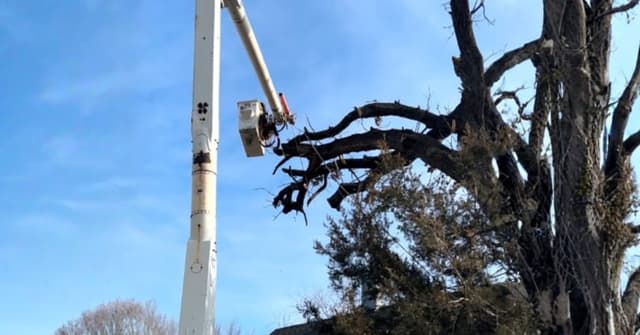
Managing a leaning tree requires more than just a chainsaw; it requires specialized equipment and a deep understanding of weight distribution. Hoffman Tree Service provides expert tree removal and hazard mitigation for homeowners across St. Joseph and the surrounding NW Missouri area. With over 10 years of experience and a BBB A-rating, our team uses high-reach bucket trucks and precision rigging to safely dismantle leaning trees that threaten your home. Whether you need an emergency removal after a storm or a proactive safety audit, we provide the honest workmanship and dependable support your property deserves.
Frequently Asked Questions
1. Can a leaning tree be straightened with cables?
In some cases, young trees can be staked and straightened. However, for mature trees with structural root failure, cabling is usually a temporary fix, and removal is often the only permanent safety solution.
2. How much of a lean is considered “safe”?
Generally, a lean of less than 4 or 5 degrees that has been present for years is not a cause for panic. Anything exceeding 15 degrees, especially if the lean is new, is considered high-risk.
3. Does homeowner’s insurance cover the removal of a leaning tree?
Most policies only cover removal if the tree has already fallen and caused property damage. However, removing a leaning tree proactively is much cheaper than paying a deductible and repairing a crushed roof.
4. Why is it dangerous to cut down a leaning tree myself?
Leaning trees have “stored energy.” When you cut into the wood, the weight of the lean can cause the tree to “barber-chair” or split vertically, which can be fatal for the person operating the saw.
5. What causes a tree to suddenly start leaning?
The most common causes are root rot, saturated soil, nearby construction that severed roots, or extreme wind events that partially uprooted the tree.
6. Will a leaning tree eventually fall?
Gravity is persistent. While a tree may stay leaning for years, the weight of the canopy grows every year, eventually exceeding what the compromised root system can support.
7. Can I save a leaning tree by pruning it?
Sometimes “weight reduction” pruning can help stabilize a tree by removing the heavy limbs on the leaning side, but this should only be done after a professional assessment.
8. How long does it take Hoffman Construction to remove a leaning tree?
Most residential removals can be completed in a single day, depending on the size of the tree and its proximity to structures.
Summary Checklist: When to Remove a Leaning Tree
| Condition | Risk Level | Recommended Action |
| Sudden Lean After Storm | Critical | Evacuate the fall zone and call for emergency removal. |
| Soil Heaving at Base | Critical | Root anchor has failed; immediate professional intervention required. |
| New Lean Toward House | High | Schedule a professional removal before the next wind event. |
| Slow, Natural Growth Tilt | Low | Monitor annually for changes in bark or soil stability. |
| Visible Decay at Root Flare | Moderate to High | Inspect for root rot; removal may be necessary to prevent falling. |
Final Advice
The decision to remove a tree is often emotional, but when a lean is involved, the decision must be based on physics and safety. In St. Joseph, the combination of expansive clay and high-velocity wind creates a “lever effect” that most compromised root systems cannot withstand. If you notice a change in the angle of your tree or see the earth shifting at its base, you are witnessing the early stages of a mechanical failure. Proactive removal is the most responsible way to manage your property and ensure that a beautiful tree does not become a destructive force.
Reviewed by a Certified Arborist
This horticultural analysis has been reviewed to ensure all information regarding tree biology and storm safety meets industry standards.
Author Bio: Hoffman Tree Service Editorial Team
The team at Hoffman Tree Service has over a decade of experience managing property safety and tree health in Saint Joseph, MO. We specialize in hazard mitigation, tree removal, and expert construction services for both residential and commercial clients.