Key Takeaways
- Dynamic Loading: Wind is a hammer blow that twists and bends tree fibers constantly.
- The Sail Effect: A thick, unpruned canopy increases the force applied to the trunk and roots.
- Root Anchor Failures: Saturated Missouri soil makes trees more susceptible to windthrow or uprooting.
- Brittle Species: Silver Maples and Bradford Pears are particularly vulnerable to Missouri’s high-velocity winds.
- Structural Mitigation: Professional crown thinning allows wind to pass through the tree, significantly reducing stress.
In Northwest Missouri, the wind is a constant force that shapes our landscape and our lives. From the persistent north-westerly winter gusts to the high-velocity derechos of summer, our trees are under a perpetual state of mechanical stress. While trees are biologically engineered to adapt to wind through a process called thigmomorphogenesis, which is the growth of thicker trunks and stronger roots in response to motion, extreme weather events often exceed these natural limits. For homeowners in St. Joseph, understanding how wind interacts with your trees is the first step toward preventing catastrophic property damage.
The Science of Wind Loading
When wind hits a tree, it creates drag. Because a tree is flexible and porous, it does not just stand still; it reconfigures itself to let air pass. However, as wind speed doubles, the force applied to the tree quadruples. This is known as wind loading. In a normal breeze, a tree might sway gently to dissipate energy. During a Missouri storm, that energy becomes a massive force that pulls at the root system and compresses the wood on the leeward side of the trunk.
The Sail Effect
Think of your tree’s canopy as a giant sail on a boat. In a healthy, well-pruned tree, wind passes through the gaps between branches. However, trees with overly dense canopies or lion-tailed branches, where all the weight is at the ends, act like a solid wall. This sail effect transfers massive amounts of energy down the trunk and into the root system. If the roots cannot hold against the leverage of the trunk, the tree fails. This is why proper pruning is not just about looks; it is about aerodynamic safety.
Common Types of Wind-Related Failure
Missouri storms typically cause three distinct types of wind failure that every property owner should recognize.
1. Windthrow or Uprooting
This happens when the loading force on the canopy exceeds the strength of the root-soil bond. In St. Joseph, our clay-heavy soils often become saturated during spring rains, making it much easier for the wind to literally pull the root plate out of the ground. When the soil is wet, it acts as a lubricant rather than an anchor.
2. Stem Failure or Trunk Snapping
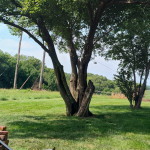
Trees with internal rot or cavities may appear healthy but lack the tensile strength to bend. Instead of flexing with the wind, the trunk snaps. This often occurs at the site of a previous wound, a fungal growth, or where two co-dominant trunks meet in a weak union.
3. Crown Twist
If a tree has an asymmetrical canopy, the wind applies unequal pressure to different sides. This causes the tree to twist as it sways. This torsional stress can create deep, vertical cracks in the trunk that compromise the tree’s future stability. Over time, these cracks can become entry points for pests and decay.
Why St. Joseph Trees are at Higher Risk
Our local environment in St. Joseph presents unique challenges for tree health. Northwest Missouri is a prime target for straight-line winds and derechos, which are long-lived wind storms that can produce tornado-strength damage in a single direction. Unlike a tornado, which is localized, a derecho can impact an entire county at once.
Furthermore, many common St. Joseph species are brittle-wood trees. Silver Maples and Bradford Pears grow quickly, which made them popular for new housing developments decades ago. However, fast growth often results in wood that lacks the dense, interlocking fibers found in slower-growing species like Oaks or Hickories. These species are often the first to fail during a 50-mph gust.
Identifying Wind-Stressed Trees Before the Next Storm
One of the most dangerous aspects of wind stress is that it is often cumulative. A tree might survive one storm but suffer micro-fractures in its roots or trunk that make it vulnerable to the next. Homeowners should perform a property walk-through after any significant wind event. Look for soil heaving, which looks like mounded dirt or cracked earth around the base of the tree. This is a sign that the roots have shifted. Also, check for new learning. If a tree that was once straight now tilts toward your home or a power line, it is a critical hazard.
Mitigation through Structural Pruning
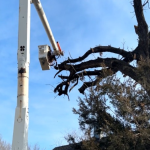
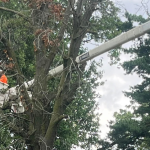
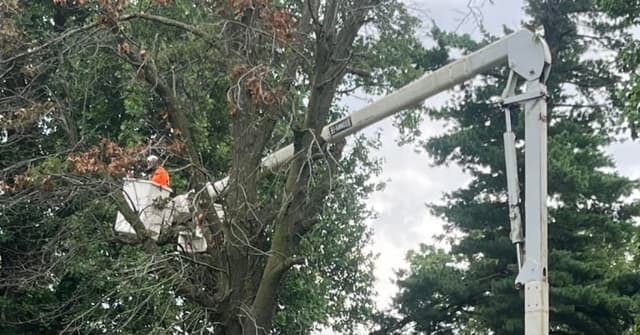
Preparation is the best defense against Missouri wind damage. Structural pruning can substantially reduce the sail effect. This involves selective thinning of the interior branches of the canopy. By opening up the tree, we allow the wind to blow through the branches rather than against them. This significantly reduces the torque applied to the trunk. Additionally, crown reduction can help lower the center of gravity on a top-heavy tree, making it much more stable during high-wind events.
Keep Your Property Safe with Hoffman Tree Service
Protecting your home from Missouri’s unpredictable winds requires expert intervention. Hoffman Tree Service specializes in wind-resistance pruning and hazard mitigation. Our BBB A-rated team uses advanced bucket trucks to safely thin canopies and remove overextended branches before they become a liability. Whether you need a preventative safety audit or 24/7 emergency storm cleanup, we provide the honest, reliable service St. Joseph has relied on for over a decade. We are committed to keeping your property safe from the unique challenges of the Missouri climate.
Frequently Asked Questions
1. At what wind speed do trees start to break?
For healthy trees, damage usually occurs at speeds above 50 to 60 mph. However, for trees with existing structural defects, failure can begin at speeds as low as 25 to 30 mph.
2. Can you tell if a tree is stressed before it falls?
Yes. Look for soil heaving at the base, new cracks in the trunk, or branches that are hanging lower than usual. These are indicators that the tree’s internal structure has been compromised.
3. Does topping a tree make it safer in the wind?
Absolutely not. Topping creates weak, vertical “sucker” growth that is much more likely to break in future storms. Proper crown thinning is the only safe way to reduce wind resistance.
4. Why do trees fall after it rains, even if the wind is not that strong?
Saturated soil loses its grip on the roots. When the soil is waterlogged, the roots can easily slip, allowing the weight of the tree to pull it over even in moderate gusts.
5. Which Missouri trees are most wind-resistant?
Oaks, Hickories, and Bald Cypress are generally more wind-resistant due to their deep root systems and dense wood fibers.
6. What is a widow-maker?
This is a large, dead branch hanging loosely in a tree canopy. Wind can dislodge these at any time, posing a fatal risk to anyone walking below.
7. Should I be worried about a naturally leaning tree?
A natural lean toward the sun is usually safe, but a new lean that appeared after a storm is a critical emergency.
8. Does Hoffman Construction offer free estimates for storm prep?
Yes. We offer free estimates for homeowners in the St. Joseph area looking to secure their property before the peak of the storm season.
Summary Checklist: Wind Stress Indicators
| Condition | Risk Level | Recommended Action |
| Dense or Overgrown Canopy | Moderate | Schedule crown thinning to reduce the sail effect. |
| Cracks After a Gust | Critical | Call for an immediate structural assessment. |
| Soil Mounding at Base | Critical | Root anchor failure detected; emergency removal likely. |
| Asymmetrical Growth | High | Prune to balance weight and reduce crown twist. |
| Brittle Species (Maple/Pear) | Moderate | Regular maintenance is required to manage weak wood. |
Final Advice
A tree’s survival in a high-wind event depends less on its size and more on its flexibility and structural integrity. In St. Joseph, where clay soils soften rapidly under heavy spring rains, even a seemingly solid tree can lose its anchor point if the canopy creates too much drag. Rather than reacting to fallen limbs after a derecho or ice storm, the most insightful strategy is to monitor the root plate for movement and ensure the crown is thinned to allow air passage. If you identify a structural imbalance or see soil shifting at the base, these are biological warnings that the tree’s mechanical limits have been reached. Seeking a professional evaluation is about risk management and ensuring your landscape can withstand the dynamic pressures of the Missouri climate.
Reviewed by a Certified Arborist
This horticultural analysis has been reviewed to ensure all information regarding tree biology and storm safety meets industry standards.
Author Bio: Hoffman Tree Service Editorial Team
The team at Hoffman Tree Service has over a decade of experience managing property safety and tree health in Saint Joseph, MO. We specialize in hazard mitigation, tree removal, and expert construction services for both residential and commercial clients.